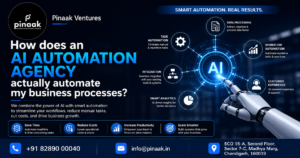

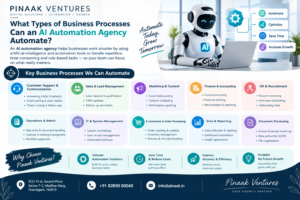
An AI automation agency can automate repetitive, rule-based business processes such as lead capture, sales follow-ups, customer support, email workflows, marketing tasks, data entry, scheduling, invoicing, HR onboarding, and internal reporting. The goal isn’t replacing people — it’s removing manual busywork so teams can focus on strategy, relationships, and decision-making.
Most businesses lose hours every week to tasks that don’t require human judgment. Someone has to copy a lead’s details from a form into a spreadsheet. Someone has to send the same follow-up email to every new customer. Someone has to manually update a CRM after every sales call. These tasks aren’t complicated, but they add up, and they pull skilled employees away from work that actually grows the business.
This is where an AI automation agency comes in. Rather than replacing entire departments, an AI automation agency identifies which parts of a workflow are repetitive, data-heavy, or communication-driven, and builds systems that handle those parts automatically. The result is faster turnaround times, fewer errors, and teams that spend more time on decisions only humans can make.
This article breaks down the specific business processes an AI automation agency can automate, what each workflow typically looks like, and where human oversight still matters.
Why Do Businesses Need an AI Automation Agency?
Business owners, operations managers, and sales and marketing teams often juggle dozens of small, repetitive tasks alongside their core responsibilities. Individually, these tasks seem manageable. Together, they consume time that could otherwise go toward closing deals, serving customers, or planning strategy.
An AI automation agency specializes in identifying these bottlenecks and designing automated workflows that fit a business’s existing tools and processes. Choose an AI automation agency over building automation in-house if your team lacks dedicated technical resources or wants a faster path to results — this is especially relevant for small and mid-sized businesses in India that are scaling operations without scaling headcount at the same pace.
Which Business Processes Can an AI Automation Agency Automate?
- Lead Capture and Lead Qualification
Every business with a website, ad campaign, or social media presence generates leads. But raw leads aren’t equally valuable — some are ready to buy, and others are just browsing.
An AI automation agency can build workflows that automatically capture leads from forms, chatbots, or landing pages, then qualify them based on predefined criteria like budget, location, or intent. For example, a website enquiry can be captured, categorized by urgency or interest, and routed directly to the right sales representative without anyone manually reviewing the form.
This kind of AI workflow automation benefits businesses with high enquiry volumes, such as real estate firms, educational institutes, and service-based companies. Human involvement is still valuable for the final qualification call and relationship-building once a lead is flagged as high-priority.
- Sales Follow-Ups and CRM Updates
Sales teams often lose deals not because of poor pitches, but because of delayed or forgotten follow-ups. Manually updating a CRM after every call, email, or meeting is time-consuming and easy to skip when things get busy.
Automated business processes here can include auto-generated follow-up reminders, personalized follow-up emails triggered by specific customer actions, and automatic CRM updates pulled directly from call logs or email threads. This keeps sales pipelines accurate without demanding constant manual entry.
Businesses with longer sales cycles — like B2B service providers or SaaS companies — tend to see the biggest impact here, since consistent follow-up often determines whether a deal closes.
- Customer Support and Query Handling
Customer support teams frequently answer the same questions repeatedly: order status, refund policies, pricing details, or troubleshooting steps. Handling these manually, especially at scale, slows down response times and frustrates customers waiting for simple answers.
AI-powered business automation can resolve this through chatbots or automated ticketing systems that instantly answer common queries, route complex issues to the right human agent, and send status updates without manual follow-up. E-commerce businesses, SaaS companies, and service providers with high query volumes benefit most from this type of automation for businesses.
Complex complaints, emotionally sensitive issues, and negotiation-heavy conversations still need a human agent — automation should handle the repetitive first layer, not replace empathetic support entirely.
- Email and Communication Workflows
Businesses send countless emails: welcome messages, appointment confirmations, payment reminders, and re-engagement campaigns. Writing and sending each one manually isn’t practical once customer volume grows.
An automated workflow can trigger emails based on specific actions — a new signup, an abandoned cart, or an upcoming renewal — without anyone drafting and sending each message individually. This ensures timely, consistent communication across every customer touchpoint.
- Marketing Workflow Automation
Marketing teams manage multiple moving parts: social media posting, ad performance tracking, content distribution, and audience segmentation. A lot of this work is repetitive scheduling and data monitoring rather than creative strategy.
Marketing workflow automation can handle scheduled content publishing, automated ad performance reports, and audience segmentation based on behavior or demographics. This frees marketing teams to focus on campaign strategy, creative direction, and brand positioning — the parts of marketing that genuinely need human insight.
- Data Entry and Data Processing
Manual data entry is one of the most time-consuming and error-prone tasks in any business. Whether it’s transferring information between systems, updating spreadsheets, or processing forms, this work rarely requires human judgment — just accuracy and consistency.
Business automation solutions can extract data from documents, forms, or emails and input it directly into the relevant system, cross-check entries for errors, and flag inconsistencies for review. Finance teams, HR departments, and operations staff typically see immediate time savings from this type of automation.
- Appointment and Meeting Scheduling
Coordinating meeting times across multiple people, especially across departments or time zones, often turns into a long email or chat thread. Scheduling tools powered by automation eliminate this back-and-forth entirely.
An AI automation agency can implement systems that let clients or team members book available slots directly, send automatic reminders, and reschedule when conflicts arise — all without manual coordination. This is particularly useful for consultants, clinics, agencies, and any business that runs on appointments.
- Invoice, Document and Administrative Workflows
Generating invoices, tracking payments, and managing recurring paperwork are necessary but low-value uses of an employee’s time. Automated systems can generate invoices based on completed orders or services, send payment reminders automatically, and organize documents into searchable, structured systems.
This type of workflow automation agency solution is especially valuable for businesses that handle high volumes of transactions or paperwork, such as accounting firms, consultancies, and service providers.
- HR and Employee Onboarding Processes
Onboarding a new employee involves paperwork, account setup, training schedules, and repeated communication — often duplicated for every new hire. HR professionals frequently spend hours on tasks that follow the same steps each time.
Automation can handle document collection, account and access provisioning, and scheduled onboarding communications like welcome emails and training reminders. This lets HR teams focus on culture-building, employee development, and addressing individual concerns rather than repetitive administrative steps.
- Reporting, Notifications and Internal Workflows
Businesses generate constant internal activity — sales numbers, inventory levels, task completions, project updates — that need to be tracked and communicated. Manually compiling reports or sending status updates takes time that could go toward acting on that information instead.
An AI automation agency can set up automated reporting dashboards, real-time alerts for key metrics, and internal notifications triggered by specific events, such as low inventory or missed deadlines. This ensures decision-makers get timely information without waiting on manual compilation.
Where Human Involvement Still Matters
Automation works best on repetitive, rule-based, and data-heavy tasks. It’s not designed to replace judgment-driven work like closing high-value deals, resolving sensitive customer complaints, or making strategic business decisions. An experienced AI automation agency will design workflows that clearly separate what should be automated from what still needs a human touch — this balance is what makes automation sustainable rather than disruptive.
Getting Started with Business Process Automation
Identifying which processes to automate starts with a simple audit: look at where your team spends repetitive, low-judgment time each week. Lead capture, follow-ups, data entry, scheduling, and internal reporting are often the easiest starting points, since they offer quick wins with minimal disruption to existing workflows.
If you’re exploring AI automation services for your business, working with a dedicated AI automation agency can help you map out these opportunities, design workflows suited to your specific operations, and implement systems that scale as your business grows.
Frequently Asked Questions
What business processes are easiest to automate first?
Lead capture, data entry, appointment scheduling, and email follow-ups are typically the easiest processes to automate first, since they’re repetitive, rule-based, and don’t require complex judgment calls.
Will automation replace my customer support or sales team?
No. Automation handles repetitive first-layer tasks like answering common queries or sending follow-up reminders, while your team continues to manage complex conversations, negotiations, and relationship-building.
How long does it take to implement AI automation for a business?
Timelines vary based on process complexity, but simple workflows like email automation or lead routing can often be implemented within a few weeks, while more complex, multi-department systems may take longer.
Is AI automation only useful for large companies?
No. Small and mid-sized businesses often benefit the most, since automation lets smaller teams manage higher workloads without proportionally increasing headcount.
What’s the difference between business process automation and AI automation?
Business process automation follows fixed rules for repetitive tasks, while AI automation can also analyze data, make decisions within set parameters, and adapt workflows based on patterns — offering a more flexible layer of automation.